Friday, September 26, 2014

Turf Birds

Here's a find from a few days ago:

This is an American Golden Plover (Pluvialis dominica). He's migrating through, on his way from the tundra of northern Canada to the pampas of Argentina. As a plover, he would be considered a shorebird, and we did in fact find him on a shore (a lakeshore, but...):

This was at Illinois Beach State Park, here in Lake County. Around here, these birds aren't easy to find. Most of the large plovers that move down the lake turn out to be these guys:

These are Black-bellied Plovers (Pluvialis squatarola). They breed in the same Arctic tundra, but many of them spend the winter along the Gulf and Atlantic Coasts instead.

As I said, Golden Plovers are hard to find here in Lake County. But elsewhere in Illinois... A significant portion of the world's population of this species migrates through central Illinois, where a good day scouring sod farms (with a scope, preferably) can yield several hundred of them. Sod farms, of course, can hardly be considered shorelines, but some "shorebirds" actually prefer them. Here's another example:

This is a Buff-breasted Sandpiper (Calidris subruficollis), another sod farm specialist, and another species more easily found in the Midwest than just about anywhere else.

This preference made sense, when this area was full of prairies, prairie fires, and bison. Now that the bison are gone, most of our prairies are tiny little patches, and prairie fires are carefully managed, they seem to be dependent upon our desire for short, green grass. But sod farms are, after all, businesses, and they have no choice but to respond to the economic environment. These days, many of our local sod farms have been slowly converting to corn, as demand for sod goes down. What this means for Golden Plovers and Buff-breasted Sandpipers, we don't really know. But it does illustrate an intriguing way in which economics can impact the natural world we live in.

Monday, September 15, 2014

A Melodrama For Three Parts

Here's a beautiful little critter that came by our hawkwatch yesterday:

This is a Merlin (Falco columbarius), another small falcon. Whereas Kestrels are all about elegance and grace, Merlin are all about power and speed. We sometimes say that Merlin shouldn't be a two-syllable word, because you don't have the time to say it!

Here's one dining on the wing -- they do this a lot as they migrate south.

What's he eating? Probably a close relative of this guy:

This is a Canada Darner (Aeshna canadensis) that also showed up on the hill yesterday. We don't see many of them, but we do see a lot of Common Green Darners, in the same family. (Although in a different genus -- they're formally known as Anax junius.) They appear to be a favorite snack for migrating Merlin.

Darners are also voracious predators of smaller insects, with darners specializing in flying prey.

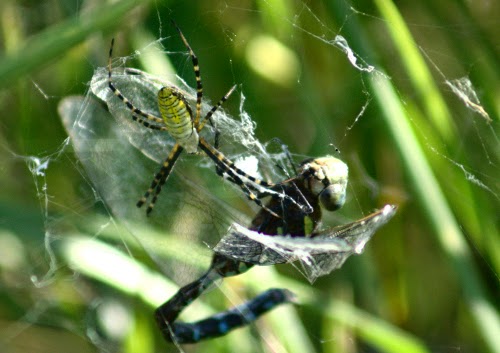
This particular guy, though, fell afoul of yet another predator:

This beauty is a Banded Argiope (Argiope trifasciatus). She's a big spider, with a body close to an inch in length, and she's going to need every bit of her size and venom:

You may have heard people talk about the food chain. Some might even understand the concept. But the food chain is a wonderful example of what Jack Cohen and Ian Stewart call Lies to Children. (aka education) Nature is so much more complex than a simple chain -- here we have a notable predator (the darner) being eaten by two other predators (the Merlin and the spider), with nary a producer (i.e. plant) in sight -- any plant is at least two steps back in the system, and possibly more. If we had followed this darner through his entire life, we might well have found him eating a baby Argiope trying to reach a new home. Or we might have seen him eating a mosquito that had just fed on a female Merlin returning to her nest with another dragonfly for her hungry chicks.

Lies to Children refers to simplified stories that we tell children (or college students, etc.) so that later on, they're ready to understand the more complicated truth. Except that science is, in the end, about telling each other stories about how the world works, and since the world is bigger and more complex than our poor brains, we have to tell each other lies as well. We can, of course, hope to find more accurate lies, and who knows, maybe sometimes we do hit the real truth. After all, we really do know more about how the world works than we ever used to. But without a teacher out there to tell us how we did, we can never really know we've got it right. We can figure out that we're less wrong than we once were, though, and that's a useful thing indeed.

Friday, September 5, 2014

Making Sense of Hawks

We started our hawkwatch Saturday, and we've had a few things to look at so far. (The first couple of weeks are always rather slow -- if you want to be sure that you're catching the entire migration, you've got to put up with some slow days.)

This beauty came by last Sunday:

He's an immature Red-tailed Hawk (Buteo jamaicensis). He didn't appear to be migrating, though, which isn't surprising. We know they nest in the park where we count.
On Monday, this lovely lady took a look at our site:

This is a female American Kestrel (Falco sparverius). She had caught something, possibly a grasshopper, and we watched her eat on the wing as she went by.

The Kestrel is, as the Latin name suggests, a falcon, in the family Falconidae and the order Falconiformes. She's got a strongly hooked, sharply pointed bill, strong feet with large pointed claws, and long, sharply pointed wings to enable her to fly very fast and maneuver very efficiently. The hawk is in the family Accipitridae (Accipiter simply means hawk in Latin). While the wings aren't sharply pointed, the bill and feet are very similar, and the wings are still long enough to allow for impressive flying abilities. Both families also specialize in eating not only other animals, but frequently other chordates. It's probably not a surprise that traditionally, then, the Accipitridae has been included in the Falconiformes.

What may be a surprise, though, is that they are no longer placed there. In fact, Accipitridae is now in the order Accipitriformes (formed when they were removed from Falconiformes). What's probably more of a surprise is that the Accipitriformes are now considered to be the sister group to a clade of owls, trogons, hornbills, kingfishers, and woodpeckers, while the Falconiformes are seen as the sister group of a clade composed of songbirds and parrots.

And what should we make of this guy:


This is a Turkey Vulture (Cathartes aura), in the family Cathartidae. The family is strictly New World, with 7 species, 3 of which are found in North America. (There are a few finds that suggest they were more widespread in the Pleistocene.) He has a nicely hooked bill, but the feet aren't nearly as strong, and while he's also a chordate eater, he very rarely kills for a meal. Vultures are patient critters that wait for animals to die on their own before they dine.

Historically, they have been placed in the Falconiformes. Before that order was split, though, the Cathartidae were moved into the Ciconiiformes, with a number of authors arguing that they were actually similar to storks. (This discussion only applies to the Cathartidae -- Old World vultures have always, to my knowledge, been included in the Accipitridae.) Some authors subsequently have placed them in an order all their own, Cathartiformes, while others have actually argued for a label of incertae sedis (aka "we have no idea what these things really are!"). The same large-scale analysis that led to the Accipitriformes, though, supported placing the Cathartidae back with the hawks, and at the moment, the AOU checklist has them in Accipitriformes with the hawks, eagles, kites, and Secretary Bird.

Through it all, we've been faithfully counting all of them, and we'll of course continue to do so. Knowing about the evolutionary history is wonderful, but keeping them around is a pretty important goal as well, and we hope that keeping track of them is a small part of that. With luck, I'll never have to try to communicate the thrill that we used to get watching them sail past.

Oh, and just because, here's a King Vulture (Sarcoramphus papa) from the St. Louis Zoo:

Sunday, August 24, 2014

Butterflies, Moths, and...?

Fall semester starts Tuesday, and hawkwatch starts Saturday, so it's about time I put something up. Here's a little selection of moths from this month:

This is a Primrose Moth (Schinia florida):


This one's a Bleeding Flower Moth (Schinia sanguinea):

And this one's a Polymorphic Pondweed Moth (Parapoynx maculalis):

These guys might well make one ask "Why are these moths and not butterflies?" Which might well lead to the question "What IS a moth, anyways?" and "What is a butterfly?" The first version of the answer is, they're all insects in the order Lepidoptera. Wonder of wonders, they're also all of the Lepidoptera; everything in this order is called either a butterfly or a moth. (Well, sort of... more on that in a moment.)

One of the older butterfly guides had an intro where the author tried to answer the question "What is a butterfly?" by saying, roughly, that a butterfly was brightly colored and flew in the daytime. But of course, some things we call moths fit this very nicely. He then pointed out that he's seen crepuscular butterflies in the tropics, so it's not an easy question at all. And if we're using color as a criterion, then what do we make of this guy?


This is a Hackberry Emperor (Asterocampa celtis).


And this is a Common Checkered Skipper (Pyrgis communis):

This last one is the sort of... And that gets us into the heart of the issue. The skippers have been considered a separate suborder, and currently are listed as a superfamily within the Rhopalocera, along with the butterflies (also a superfamily). Most sources do call them butterflies, in any case. The Rhopalocera, though, is listed as one suborder within the Macrolepidoptera, which includes 4 other superfamilies. Although the Macroleps include 60% of the species in the Lepidoptera, they actually include a minority of the superfamilies (and families, not coincidentally). All of those other superfamilies are called moths!

So, what's a butterfly? It's something in the Rhopalocera, possibly excluding the skippers. What's a moth? Any lepidopteran that isn't a butterfly! (Or a skipper....)

Things were often much simpler before we started doing proper phylogenetic analyses, but I'd rather deal with the complications if it means a better understanding of where things came from.

Sunday, July 13, 2014

Growing Pains

Mid-semester is always a busy time. The bugs don't care, though, so here's a nice find from last week:
Coral Hairstreak (Satyrium titus), Illinois Beach SP, Lake Co, IL 7/9/2014
This is a Coral Hairstreak, (Satyrium titus). They're quite common around here, and always a welcome sight in July.

Here's what one looked like last month:
Coral Hairstreak (Satyrium titus), Illinois Beach SP, Lake Co, IL 6/14/2014
Everyone knows that caterpillars turn into butterflies, right? (Well, most of them turn into moths, but that's a story for another day.) But what about other insects?
Dragonfly Nymph (order Odonata), College of Lake County, IL, 7/16/2012

Many groups undergo metamorphoses similar to butterflies. This frightening critter is a young dragonfly. (Dragonfly nymphs are very hard to ID to species, I'm afraid.)
Racket-tailed Emerald (Dorocordulia libera), Gander Mt. Forest Preserve,
Lake Co, IL 5/23/2012
And here's an adult, in this case a Racket-tailed Emerald (Dorocordulia libera).

Seaside Grasshopper (Trimerotropis maritima), Illinois Beach SP,
Lake Co, IL 7/21/2013
Here's a Seaside Grasshopper (Trimerotropis maritima). Despite the name, they're quite common in the old sand dunes at Illinois Beach State Park. And here's a young one:
Seaside Grasshopper (Trimerotropis maritima), Illinois Beach SP,
Lake Co, IL 6/12/2014
You can tell it's young by the short, stiff wing pads, compared to the long, mobile wings of the adult. Clearly, though, grasshoppers (like the rest of the order Orthoptera) don't undergo a full metamorphosis. Neither do the true bugs in the order Hemiptera.

So there is variation in metamorphosis in insects. (We don't see it at all in Arachnids - young spiders or scorpions look like tiny versions of their parents.) Any time we see variation across a group, it provides a possible test of evolutionary mechanisms. In this case, Kukalova-Peck discussed the fossil record of insects back in 1978, concluding that metamorphosis had evolved separately in several different lineages. (1) Thirty years later, Belles agreed, arguing that we can trace the more complete, holometabolan lineages through hemimetabolan fossil stages, (2) while still concluding that the story is murky at best.

In 2001, Yang used insect metamorphosis to test the hypothesis that organisms with modular developmental strategies (like metamorphic insects) should show more diversification over time. They found that, indeed, holometabolan lineages showed more diversification than ametabolan or hemimetabolan ones. (3)

(1) Kukalova‐Peck, J. (1978). Origin and evolution of insect wings and their relation to metamorphosis, as documented by the fossil record. Journal of Morphology, 156(1), 53-125.

(2) Belles, X. (2011). Origin and evolution of insect metamorphosis. eLS.
 
(3) Yang, A. S. (2001). Modularity, evolvability, and adaptive radiations: a comparison of the hemi‐and holometabolous insects. Evolution & development, 3(2), 59-72.

Sunday, June 29, 2014

Beetles with a Checkered Past (and Future)

It's been a good summer so far for these beauties:
Trichodes nuttali, Illinois Beach SP, Lake Co, IL, 6/29/2014
Enoclerus analis, Lyons Woods FP, Lake Co, IL 7/30/2013

Thanasimus dubius, Lyons Woods FP, Lake Co, IL 6/2/2014

These are all Checkered Beetles, in the family Cleridae. The family is a small one, only 3600 species worldwide, with only 300 or so in North America. (That's about 1% of the 350,000 species of beetle worldwide*, and about 0.1% of the 25,000 beetles recorded from North America.)

They're predators, eating other insects. The larvae often feed on wood-boring larvae, including those of Pine Bark Beetles responsible for quite a few large-scale losses of trees in the western and south-eastern US. Which explains why this little tiny family still warrants over 5,000 citations on Google Scholar.

Interestingly, they use the sex pheromones of their prey to find them. The technical term for this is a kairomone, which is a chemical produced by one species that ends up benefiting another species. Herms, et al. looked at this in the predator-prey pair Ips pini (a bark beetle) and Thanasimus dubius (the last Clerid shown above). (1)  Billings & Cameron showed that different predatory beetles respond to different genera of pine bark beetles, an interesting bit of specialization. (2) (They also showed that pine sawyer beetles, Monochamus titillator, responded to one of the bark beetles. Given their habit of laying eggs in freshly dead pine trees, this makes sense. They only responded to one species of beetle, though, which leads me to wonder if that beetle is more lethal to the pines, or if both the bark beetle and the sawyer beetle show preferences for certain species of pine.)

Beetles can be surprisingly attractive little critters, but it shouldn't surprise me by now just how intriguing their lives can be.

*All of these figures from Bugguide.net.

(1) Herms, D. A., Haack, R. A., & Ayres, B. D. (1991). Variation in semiochemical-mediated prey-predator interaction: Ips pini (Scolytidae) andThanasimus dubius (Cleridae). Journal of chemical ecology, 17(8), 1705-1714.
 
(2) Billings, R. F., & Cameron, R.S. (1984). Kairomonal responses of Coleoptera, Monochamus titillator (Cerambycidae), Thanasimus dubius (Cleridae), and Temnochila virescens (Trogositidae), to behavioral chemicals of southern pine bark beetles (Coleoptera: Scolytidae). Environmental Entomology, 13(6), 1542-1548.
 

Friday, June 27, 2014

Return of the Prairie?

Here's a nice find from this morning, first located by a friend of mine:
Prairie Warbler (Setophaga discolor), Grant Woods FP, Lake Co, IL  6/27/2014

This is a male Prairie Warbler (Setophaga discolor), and he's only the third one I've ever run across in the county. The first one, in fact, I never did manage to see. Thankfully, they have a very distinctive voice -- a slightly buzzy, very musical series of notes running up the scale. Their song always reminds me of Arethra Franklin trying to sing a Northern Parula ditty.

They breed in early-successional shrublands, which are in rather short supply in this area these days. Back in the 70's, though, they bred in Illinois Beach State Park. That habitat hasn't changed much over the years, and I don't know why they disappeared.

I mentioned that this was the third one I've found here? The first two were last year in May. Given that this guy's been singing away for at least two weeks, and he was joined by a second male, I have to wonder if this is a signal of a range expansion back into the county. In the case of this particular male, it's likely to be an unsuccessful one, since he's still singing his heart out at the end of June. (Typically, a male that's found a mate will spend a lot less time singing by now, since there's no longer any need to attract a female.) But that's the way that ranges grow -- the first few birds into a new area will probably not succeed. Once a couple of birds have found mates, and we have a few nestlings who have grown up here, then the next birds to wander into the area will see a reason to stay, and we have a new expected species.

Evolution can be seen as an exploration of the incredibly large universe of possible genetic programs, set against a wildly varying environment of constraints. An occasional individual wanders into new territory, and if it's really lucky, an entire population will someday follow it. But that's an abstract way to view things. Genetic programs only evolve when they're in a body that can actually do things, and in this case, we're seeing the abstract concept of exploration playing out in very concrete, and very musical, little warblers.